How to Specify Aluminum Components to Minimize Distortion in Machining?
2026-11-09 · CRYJT · views 1
Why Minimizing Distortion Matters in Aluminum Components
Distortion in aluminum components, especially thin wall parts, can compromise performance and assembly accuracy. Thermal expansion during machining, material anisotropy, and residual stresses are primary causes. For applications like heat sinks or precision hardware, where dimensional stability is critical, understanding how to mitigate distortion is essential. Failing to address it can lead to parts that do not meet specifications or fail in service. Aluminum alloys like 6061-T6 and 5052-H32 are commonly used, but their properties must be considered.
Key Criteria for Reducing Distortion
The first step is selecting the right aluminum alloy. 6061-T6 offers good machinability and strength, while 5052-H32 provides higher corrosion resistance. Material thickness is also critical—thinner walls are more prone to warping. Design for Manufacturability (DFM) principles should be applied, such as avoiding sharp corners and providing generous fillets. Finishing processes play a role; for instance, CNC machining can be used for secondary operations to refine dimensions after initial shaping.
How to Specify Components Correctly
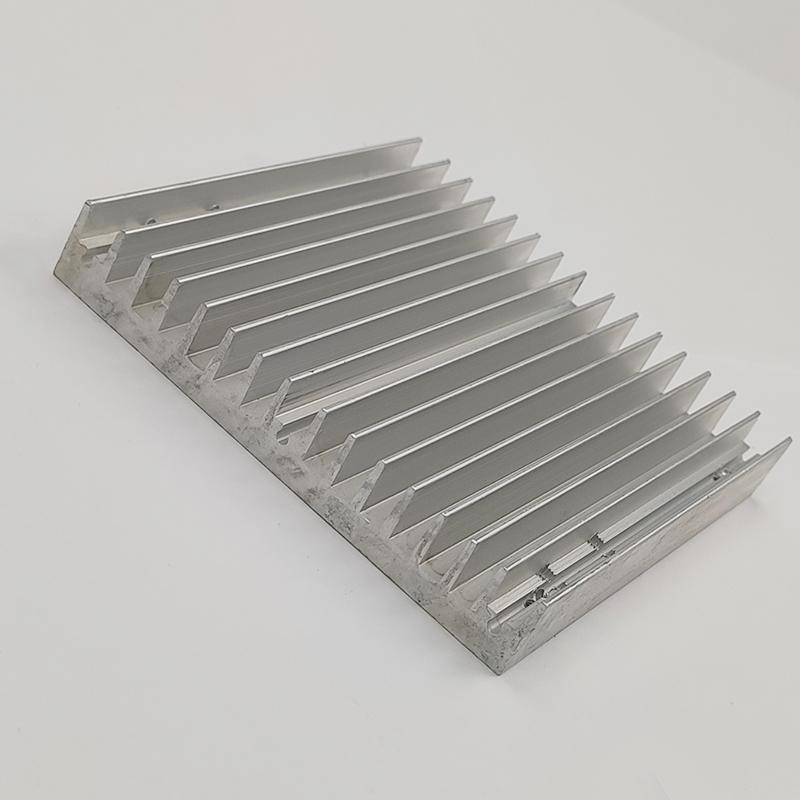
Start with a detailed engineering drawing that includes all critical dimensions and tolerances. Specify the finishing method—anodizing affects surface finish but not geometry, while CNC machining can remove material to compensate for expected distortion. For skived fin heat sinks, confirm the fin pitch (e.g., 2.0 mm (0.08 in)) and fin height (e.g., 25.0 mm (0.98 in)) against the drawing. Bonded/staked fins are an alternative but introduce interface resistance, so evaluate for vibration-sensitive applications. Always request samples to verify fit and finish.
Common Pitfalls to Avoid
A common mistake is neglecting coolant usage during CNC machining, which can exacerbate thermal stress. Uneven material removal can also cause warping—plan operations to remove material symmetrically. Storage conditions matter; aluminum parts should be stored in a climate-controlled environment to prevent stress relaxation. Heat treatment can relieve residual stresses but requires precise control to avoid over-hardening. For precision hardware, consider using 6063-T5 for extrusion, as its lower strength reduces warping tendency compared to 6061-T6.
Material Selection and Design for Distortion Resistance
Aluminum alloys influence distortion behavior. 6061-T6 is well suited for CNC-machined parts due to its balance of machinability and strength, while 5052-H32 is a good fit for corrosive environments. Wall thickness should be uniform; thin walls (e.g., 0.5 mm (0.02 in)) require extra attention. Design features like relief cuts or gussets can distribute stresses and reduce warping. Heat sinks with dense fin arrays benefit from skiving, which creates a monolithic structure with no thermal interface resistance. Bonded fins are cheaper but introduce a weak point where fins meet the base.
Finishing and Post-Machining Considerations
Anodizing enhances durability but adds no structural integrity. CNC machining is ideal for final dimensioning, but avoid deep cuts that concentrate heat. Heat treatment (e.g., T6 temper) strengthens aluminum but can make it more brittle. Inspection with coordinate measuring machines (CMM) ensures parts meet tolerances. For precision hardware, consider hard anodizing for wear resistance. Parts from manufacturers like Foshan Chuangrongyao Metal Products Co., Ltd. can be custom-made to drawings with samples available upon request. Contact Mr. Huang at +86 150 9995 1623 or info@cryjt.com for quotes.
Final Recommendations for Procurement Engineers
Always provide a detailed drawing with confirmed dimensions (e.g., fin pitch and base thickness). Specify material grade (e.g., 6061-T6) and finishing requirements. Request samples to validate distortion control. Avoid sharp corners in design and use symmetrical material removal. For skived fin heat sinks, confirm the monolithic construction benefits. Thin wall parts require extra care—consider relief cuts or annealing to reduce stresses. Manufacturers with expertise in CNC machining and aluminum extrusion can help achieve tight tolerances. For custom components, reach out to Foshan Chuangrongyao Metal Products Co., Ltd..
| Criteria | Recommendation |
|---|---|
| Material | 6061-T6 for machinability, 5052-H32 for corrosion resistance |
| Wall Thickness | Uniform; avoid 0.2 mm (0.008 in) or thinner without analysis |
| Design | Use fillets; avoid sharp corners |
| Finishing | CNC for final sizing; anodizing for surface protection |
What causes distortion in thin wall aluminum parts?
Thermal expansion during machining, material anisotropy, and residual stresses are primary causes. Coolant usage and material removal patterns influence the extent of distortion.
Which aluminum alloy minimizes distortion in CNC machining?
6061-T6 is often recommended due to its balanced properties, but 5052-H32 offers better corrosion resistance if that is the key concern.
How can design features reduce distortion?
Features like relief cuts, gussets, and fillets distribute stresses and minimize warping. Avoiding sharp corners also helps.
FAQ
Keep reading
Have a project to evaluate? Send us the drawing.
Request a Quote